

Determining how much office space your business needs is not as simple as multiplying your number of employees by one standard square-footage figure.
Two companies with the same number of employees may require completely different workplaces. A law firm may need enclosed private offices, confidential meeting rooms, document storage, and a professional reception area. A technology startup may prefer shared workstations, collaboration areas, and several smaller rooms for video calls. A hybrid company may have 20 employees but only expect eight or ten people in the office on a normal day.
The right amount of office space depends on:
- The number of people present at the same time
- The type of work they perform
- Private-office requirements
- Hybrid and remote-work schedules
- Client and visitor traffic
- Meeting-room usage
- Storage and equipment
- Accessibility and circulation
- Plans for future hiring
- Whether shared amenities are available outside your suite
Businesses should calculate their peak daily occupancy, identify the rooms they genuinely need, and compare the complete cost of each option before committing.
Barrister Executive Suites offers furnished and unfurnished private offices, team configurations, meeting rooms, shared workspace opportunities, and virtual-office programs across 23 Southern California locations. Businesses can choose a workspace that fits their present team without independently constructing and managing an entire conventional office.
Your total number of employees is not always the correct number to use when calculating office space.
Instead, determine how many people are likely to be present at the same time.
For example, a company may have:
- 20 total employees
- Five fully remote employees
- Ten hybrid employees
- Five employees who work in the office every day
Although the company employs 20 people, its typical daily attendance may be closer to ten or twelve. Its busiest team meeting might bring 15 people into the office.
In this situation, the business should calculate space using several scenarios:
- Typical attendance: The number present on an ordinary workday
- Peak attendance: The largest number expected on a recurring basis
- Special-event attendance: The number present for training, company meetings, or client events
The office should support normal and peak operations without forcing the company to pay every month for space used only a few times per year.
Larger meetings can often be accommodated through a reservable conference room rather than a permanently dedicated room inside the company’s private suite.
A Preliminary Office-Space Formula
A practical starting formula is:
Peak daily attendance × 150 to 200 usable square feet per person
This is an early planning estimate rather than a universal standard or building-code requirement. The appropriate number can rise or fall depending on the office layout, number of enclosed rooms, shared amenities, and specialized business needs.
Current federal workplace guidance uses a 150-square-foot-per-person design benchmark for federal agencies, but private businesses should treat that figure as a reference point rather than a rule.
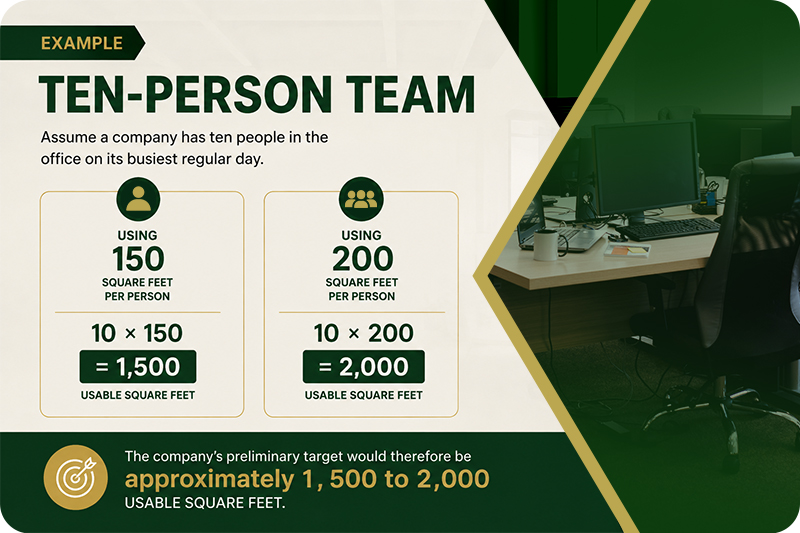
A collaborative company with shared workstations may fit toward the lower end. A client-facing professional firm with enclosed offices may require the higher end or more.
A Preliminary Office-Space Formula
A preliminary calculation rarely captures every operational detail.
After estimating the initial square footage, consider adding approximately 10% to 15% for:
- Circulation
- Storage
- Technology
- Additional furniture
- Unexpected layout limitations
- Near-term hiring
- Accessibility requirements
- Changes in work patterns
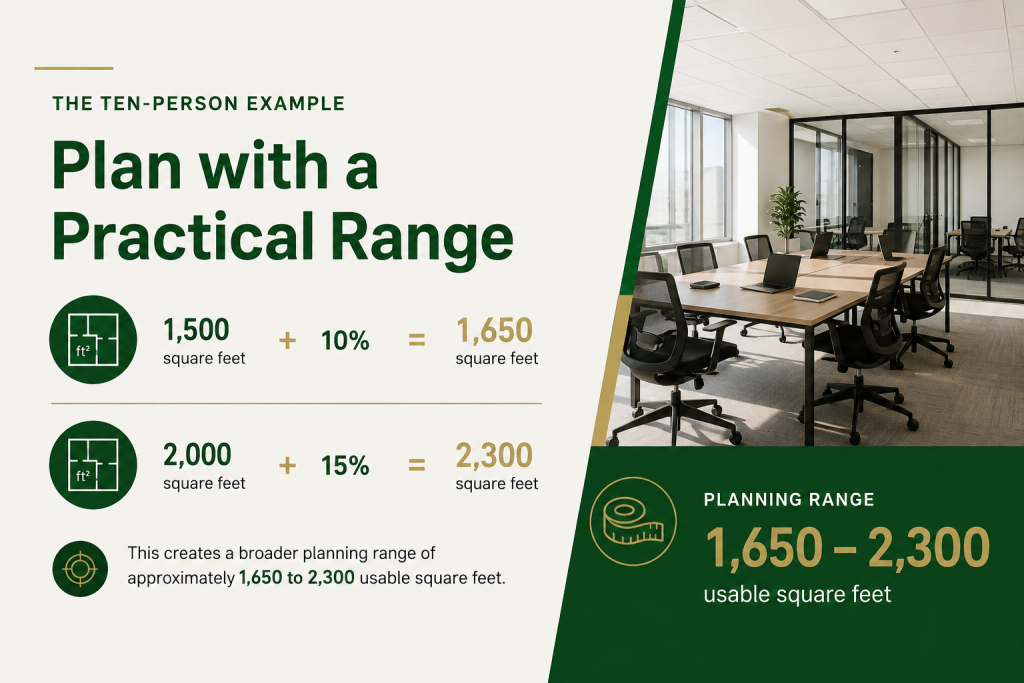
That does not mean the company should automatically lease the largest option. The final decision should reflect realistic hiring, budget, and attendance projections.
Usable Square Footage vs. Rentable Square Footage

One of the most important parts of office planning is understanding the difference between usable and rentable square footage.
Usable Square Footage
Usable square footage generally represents the area located inside the tenant’s premises.
It may include:
- Private offices
- Employee workstations
- Interior meeting rooms
- Storage rooms
- Internal hallways
- Kitchen or break areas inside the suite
Rentable Square Footage
Rentable square footage may include the usable area plus an allocated portion of shared building areas.
These shared areas can include:
- Building lobbies
- Common corridors
- Elevator areas
- Shared restrooms
- Building service areas
- Other qualifying common spaces
The Building Owners and Managers Association publishes measurement standards used to calculate rentable office areas and allocate common building space. Businesses should ask which measurement method was used and confirm whether quoted square footage is usable or rentable. See the official BOMA Floor Measurement Standards.
Example
Assume a suite contains:
- 2,000 usable square feet
- A 15% building load factor
The rentable area may be calculated as:
2,000 × 1.15 = 2,300 rentable square feet
The business may occupy approximately 2,000 square feet while paying rent based on 2,300 square feet.
Always request:
- Usable square footage
- Rentable square footage
- Building load factor
- Floor plan
- Measurement standard
- Written rental calculation
Calculate Space by Room and Function
A per-person estimate provides a starting point, but a room-by-room analysis produces a more useful plan.
The following are broad planning estimates—not mandatory dimensions. An architect, space planner, property manager, or office provider should confirm what is feasible inside a particular building.

3. Beverly Hills: A Recognized Address for Client-Facing Businesses
Beverly Hills remains one of Southern California’s most internationally recognized business addresses.
Barrister’s Beverly Hills center is located in the Bank of America Building at 9440 South Santa Monica Boulevard, Suite 301. The location offers private executive suites, team offices, meeting rooms, virtual-office programs, and professional business support.
Beverly Hills may work well for:
- Attorneys
- Financial advisors
- Wealth-management firms
- Luxury brands
- Entertainment professionals
- Healthcare and wellness professionals
- Consultants
- Real estate professionals
- Public relations and creative firms
- International businesses seeking a recognizable address
Advantages of a Beverly Hills office
For businesses that depend on presentation and client confidence, a Beverly Hills address can reinforce an established and professional image.
The location may be particularly effective when clients already conduct business in Beverly Hills, Century City, West Hollywood, West Los Angeles, or the surrounding entertainment and professional-service markets.
A flexible office arrangement can allow a smaller business to establish a Beverly Hills presence without independently leasing, furnishing, staffing, and operating an entire conventional office.
Barrister’s Beverly Hills center supports individual professionals and teams while providing access to client-ready meeting rooms and shared business infrastructure.
Consider before choosing Beverly Hills
The business should determine whether the value of the address aligns with its target market.
Review:
- Employee commute times
- Parking expenses
- Visitor parking
- Access from surrounding cities
- Meeting-room needs
- Local business requirements
- Total monthly office cost
- Whether clients actually benefit from the location
A prestigious address is most valuable when it supports the business’s customer base, positioning, and revenue strategy—not simply because it is well known.

4. Century City: A Major Professional and Corporate District
Century City is a prominent professional business district associated with law, finance, consulting, entertainment, real estate, and corporate services.
Barrister’s Century City location is inside the tower at 1801 Century Park East. The offices feature full-height windows, golf-course views, convenient access to the Westfield Century City area, and proximity to the 10 and 405 freeways.
Century City may work well for:
- Law firms
- Financial-services companies
- Investment professionals
- Management consultants
- Entertainment businesses
- Real estate companies
- Corporate satellite teams
- Executive-search firms
- Client-facing professional practices
Advantages of a Century City office
Century City provides a concentrated professional environment where businesses can operate near other major companies, law firms, advisors, and service providers.
This can be useful for companies whose work depends on frequent in-person meetings with corporate clients, attorneys, investors, executives, or professional partners.
Barrister’s Century City center offers private offices, meeting facilities, and flexible workplace services inside an established commercial district. The property’s proximity to restaurants, shopping, and client amenities can also simplify business meetings and hosted visits.
Consider before choosing Century City
Century City can carry premium office and parking costs. Businesses should compare the complete occupancy expense rather than evaluating the office rate alone.
Include:
- Office fee or base rent
- Parking
- Meeting-room charges
- Internet
- Telephone service
- Furniture
- Reception
- Utilities
- Cleaning
- Additional employee offices
- Annual increases
- Deposit or setup fees
The location may deliver significant value for businesses that regularly serve Century City clients. It may be less practical when most employees and customers are located far outside the Westside.
5. Pasadena: A Professional Hub for the San Gabriel Valley
Pasadena offers a strong alternative for companies that want a professional Southern California business location outside the central Westside.
Barrister’s Pasadena center is located at 35 North Lake Avenue, Suite 710, inside the Pasadena Financial Center. It is situated near Playhouse Village, shops, restaurants, public transportation, Old Pasadena, and other local business destinations.
Pasadena may work well for:
- Attorneys
- Accountants
- Architects and engineers
- Consultants
- Financial professionals
- Technology and research-related companies
- Nonprofit organizations
- Healthcare-related businesses
- Companies serving the San Gabriel Valley
- Professionals commuting from eastern Los Angeles County
Advantages of a Pasadena office
Pasadena can offer a professional environment with access to the San Gabriel Valley, Northeast Los Angeles, Glendale, Arcadia, and surrounding communities.
For companies whose employees and clients are concentrated east of central Los Angeles, Pasadena may reduce commuting demands while still providing a recognized commercial address and client-ready office environment.
Barrister’s Pasadena center provides private executive offices, shared-office options, virtual offices, and hourly meeting rooms for individuals and small teams.
Consider before choosing Pasadena
Pasadena may be less convenient for a company whose daily activity is concentrated in Santa Monica, Beverly Hills, Century City, or the South Bay.
Evaluate where most meetings take place and whether the office needs to serve one primary region or the entire Los Angeles market.
Quick Comparison of the Five Office Markets
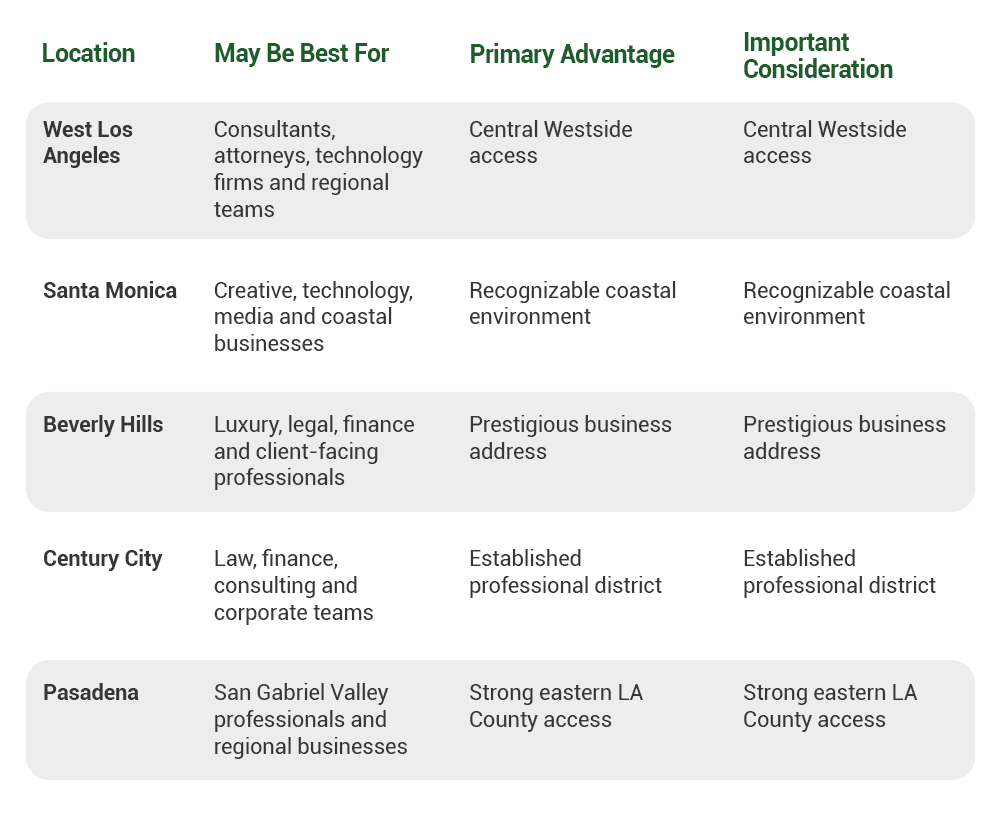
The best choice depends on the company’s customers, employees, finances, and daily operations.
Use Market Data Before Selecting a Neighborhood
Business owners should support their location decision with more than personal preference.
The U.S. Census Bureau’s Census Business Builder provides demographic and economic data, interactive maps, location comparisons, and reports that can help companies research customers, industries, and prospective markets.
This resource can help a business compare:
- Population characteristics
- Industry concentrations
- Consumer markets
- Local economic conditions
- Geographic areas
- Nearby business activity
Data does not replace a property tour, but it can help determine whether the selected location supports the company’s target market.

A location that works well for the company’s owner may create difficulties for the rest of the team.
Before committing, ask employees to estimate their expected commute during normal working hours. Consider:
- Driving time
- Public transportation
- Parking availability
- Parking cost
- Walking distance
- Evening access
- Safety
- Client travel patterns
- Airport access
Review the official LA Metro system information, test the route at the expected arrival time, and inspect the building’s parking procedures in person.
For hybrid companies, determine how often employees will actually commute. A premium location may make sense when employees gather only several times per month, while a daily workplace may require a more centrally accessible market.
An available office should not be assumed to permit every activity.
Businesses that provide healthcare, education, personal services, retail activity, frequent customer visits, specialized equipment, or other nonstandard uses may face additional requirements.
The City of Los Angeles provides its official Zoning Search and ZIMAS resources to help residents and businesses review land-use and zoning information for properties located within the city. Pasadena, Beverly Hills, Santa Monica, and other independent cities have their own local requirements and departments.
Before signing, confirm:
- Permitted business use
- Occupancy requirements
- Signage
- Visitor activity
- Operating hours
- Licensing
- Parking requirements
- Building alterations
- Local permits
Material approvals should be obtained in writing when appropriate.

Internet service should be evaluated before selecting an office—not after signing.
Ask:
- Is internet included?
- What speeds are available?
- Is the connection shared or dedicated?
- Is wired service available?
- Can the business establish a private network?
- Is backup connectivity available?
- Who provides technical support?
- Are installation or upgrade fees required?
The FCC National Broadband Map can help businesses review providers that report service availability at a particular address. Actual service inside the building should still be confirmed directly with the office provider or internet carrier.
A provider being listed near an address does not guarantee that a specific suite is already connected or that the advertised speed is available.
Employees and visitors should be able to enter and use the workplace comfortably.
During the tour, inspect:
- Accessible parking
- Route from parking to the entrance
- Building doors
- Elevators
- Interior pathways
- Restrooms
- Reception counters
- Conference rooms
- Emergency procedures
- Signage
The Department of Justice’s official ADA guidance for businesses open to the public explains accessibility responsibilities under Title III. Requirements can depend on the business, facility, services, existing conditions, and any alterations being performed.
Businesses entering a long-term lease or making improvements should consult appropriate legal, architectural, and accessibility professionals.
A low advertised office rate may not reflect the actual monthly expense.
Include:
- Base rent or office fee
- Common-area expenses
- Utilities
- Internet
- Telephone service
- Furniture
- Parking
- Reception
- Cleaning
- Repairs
- Security
- Meeting rooms
- Printing
- Mail service
- Insurance
- Setup fees
- Annual increases
- Construction or improvements
A furnished flexible office may have a higher visible monthly price than the base rent of an empty commercial suite. However, the flexible office may already include infrastructure and services that the business would otherwise need to purchase separately.
Location is only one part of the decision. Businesses should also select the workspace arrangement that fits their operations.
A dedicated private office may be appropriate when the business needs:
- Confidentiality
- Quiet
- A consistent workstation
- Client meetings
- Secure storage
- Professional reception
- Space for employees
Barrister provides private offices in several sizes and configurations, including individual offices, team offices, private suites, director suites, and executive suites.
A virtual office may work for a remote or home-based company that needs:
- A professional business address
- Mail handling
- Telephone support
- Occasional office access
- Meeting rooms
- A recognizable location without a full-time office
Barrister’s virtual-office programs can include address use, mail services, telephone answering, and meeting-room access, depending on the selected program.
A business that works remotely may only need physical space for:
- Client presentations
- Interviews
- Depositions
- Training
- Board meetings
- Confidential calls
- Temporary project work
Hourly meeting rooms and day offices can provide professional space without maintaining a permanent office.
A team office may be appropriate when several employees need to work together but the company does not want to build and operate an entire conventional suite.
Ask whether the provider can add desks, adjacent offices, or a larger configuration as the company grows.
Use the same questions at every location so you can compare the answers accurately:
- What is included in the monthly price?
- What additional charges may apply?
- Is the office furnished?
- Are utilities included?
- Is internet included?
- What internet speeds are available?
- Is professional reception provided?
- How are visitors greeted?
- Are meeting-room hours included?
- How are additional meeting hours priced?
- What parking is available?
- How much does parking cost?
- Is visitor validation offered?
- What are the building-access hours?
- Is after-hours HVAC available?
- Is cleaning included inside the office?
- Can the office be personalized?
- Can the company add another desk or office later?
- Is mail and package handling available?
- What is the minimum agreement term?
- How much notice is required to leave?
- Does the agreement renew automatically?
- Are annual price increases specified?
- What security measures are in place?
- Can the quoted services and pricing be provided in writing?
Do not rely solely on verbal promises. Important services, fees, and terms should appear in the written agreement.
A conventional office search may require the business to coordinate:
- Commercial lease negotiations
- Construction
- Furniture
- Utilities
- Internet installation
- Telephone service
- Reception staffing
- Janitorial service
- Meeting-room setup
- Security
- Repairs
- Vendor management
A flexible private office can reduce many of these setup responsibilities.
Barrister’s private offices are professionally managed and available in multiple sizes for solo professionals, growing teams, and established companies. Businesses can also explore additional Barrister locations as their geographic or staffing needs change.
Exact inclusions, optional services, pricing, parking, and agreement terms should be confirmed for the selected location.
West Los Angeles, Santa Monica, Beverly Hills, Century City, and Pasadena each offer distinct advantages.
- West Los Angeles provides central access to several Westside markets.
- Santa Monica offers a recognizable coastal location for creative and professional businesses.
- Beverly Hills supports companies that value a prestigious, client-facing address.
- Century City places businesses inside a major professional and corporate district.
- Pasadena offers strong access to the San Gabriel Valley and eastern Los Angeles County.
The best office is not automatically located in the most expensive district. It is the one that supports your clients, employees, budget, privacy requirements, and plans for growth.
Barrister Executive Suites provides private offices, team spaces, virtual-office programs, meeting rooms, and flexible workspace solutions at 23 Southern California locations.
Explore Barrister’s Southern California locations, call 800-576-0744, or email leasing@barrister-suites.com to discuss current office availability and schedule a tour.
Frequently Asked Questions
What is the best location for office space in Los Angeles?
The best location depends on where your employees and clients are based. West Los Angeles can provide broad Westside access, while Beverly Hills and Century City may appeal to client-facing professional firms. Santa Monica may suit coastal, technology, and creative businesses, while Pasadena can be convenient for companies serving the San Gabriel Valley.
Is West Los Angeles a good location for an office?
West Los Angeles can work well for businesses that need access to Santa Monica, Brentwood, Century City, Westwood, and surrounding Westside markets. Commute patterns and parking should still be reviewed carefully.
Is Beverly Hills office space only for large companies?
No. Flexible private offices and virtual-office programs can allow solo professionals and small teams to establish a Beverly Hills presence without renting an entire conventional suite.
What businesses commonly choose Century City?
Century City can be attractive to attorneys, financial professionals, consultants, entertainment companies, real estate businesses, and corporate teams that meet regularly with professional clients.
Is Pasadena considered part of the Los Angeles office market?
Pasadena is an independent city within Los Angeles County and a significant business market serving the San Gabriel Valley and surrounding communities. It can be a practical alternative for businesses that do not need a daily Westside location.
How should I compare Los Angeles office locations?
Compare employee commute times, client proximity, parking, public transportation, complete office costs, internet, meeting rooms, business services, privacy, accessibility, and potential room for growth.
What is included with a Barrister private office?
Depending on the location and agreement, a Barrister office may include furniture, utilities, internet, reception support, meeting-room access, shared business areas, maintenance, and on-site management. Exact services should be confirmed before signing.
Can I use a Barrister location without renting a full-time office?
Yes. Depending on the property and selected program, Barrister offers virtual offices, meeting rooms, day offices, membership access, and other flexible options.
Can my company move to another Barrister office as it grows?
Barrister provides multiple office sizes and locations. Moving or expanding depends on availability and the terms of the agreement, so businesses should discuss future growth requirements with the leasing team before committing.